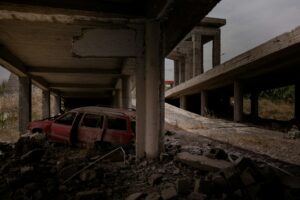
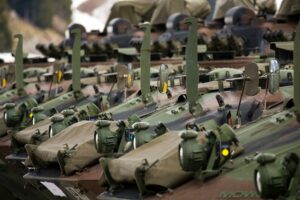
Airwars and the AI Now Institute have released a new visual investigation into how militaries are using AI in targeting decisions. It illustrates how the technologies used cause various forms of what we at RAW define as ‘beforemath harms’, namely the wrongful and harmful production, interpretation, and categorisation of data that ‘mark’ civilians as potential militants (Arentze et al. 2026).
The project walks through a fictional but realistic AI-enabled strike across six stages: sensor and data collection, surveillance, intelligence and identification, selection, deadly strike, and post-strike assessment. The story follows a single target, a phone signal, a translation error, a risk score, and a strike, showing how errors compound across a kill chain until a school teacher running a food distribution point is misidentified as a combatant. At each stage of the visual representation, embedded tech explainers unpack the specific systems at play; anomaly detection, automated translation, social scoring, link analysis, target recognition, and where each one is prone to failure. It closes by connecting this fictional case to real, documented incidents, including Airwars’ own investigation into an AI-assisted strike that killed an Iraqi student, and reporting that in some US operations, only two of six kill chain stages still involve a human.
The technology depicted is not speculative. It draws on documented systems already in use in Ukraine, Gaza, and Iran.
The project was produced by Sophia Goodfriend (Airwars / Cambridge University), Dr. Heidy Khlaaf (AI Now Institute), Namir Shabibi, Joe Dyke, and Nathan Walker, with 3D animation and illustration by Azul De Monte.
Explore the visual project here: ai-killchain.airwars.org
See here for our RAW article on Algorithmic Harm: Arentze et al. (2026) Tracing algorithmic harm: from innovation to deployment and impact on civilians. Critical Studies on Security.